Microbial Investigations & Mitigation Services

Mold • Moisture Assessment and Control • Bacteria and Endotoxin

Click to jump (smooth scroll)

Mold

IEE's approach to mold investigations, data analyses and preparation of detailed mitigation plans uses elements adopted from governmental / professional organizations such as EPA, ACGIH and AIHA. Our typical mold projects include one or more of the following steps:

Assessment
  • Visual / olfactory assessment
  • Surface samples of visual mold growth
  • Air sampling to assess exposure and content cleaning requirements
  • Destructive testing to determine extent of mold growth concealed in building cavities
Mitigation
  • Primary and secondary engineering controls
  • Mechanical removal of mold growth (zero or minimal use of biocides)
  • Cleaning of particulates from indoor air and surfaces
Clearance
  • Visual inspection
  • Air sampling
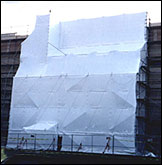
Shrink wrap containment exterior hospital
A shrink wrap containment, on the exterior of a three story hospital, that was used during removal of mold contaminated building materials.
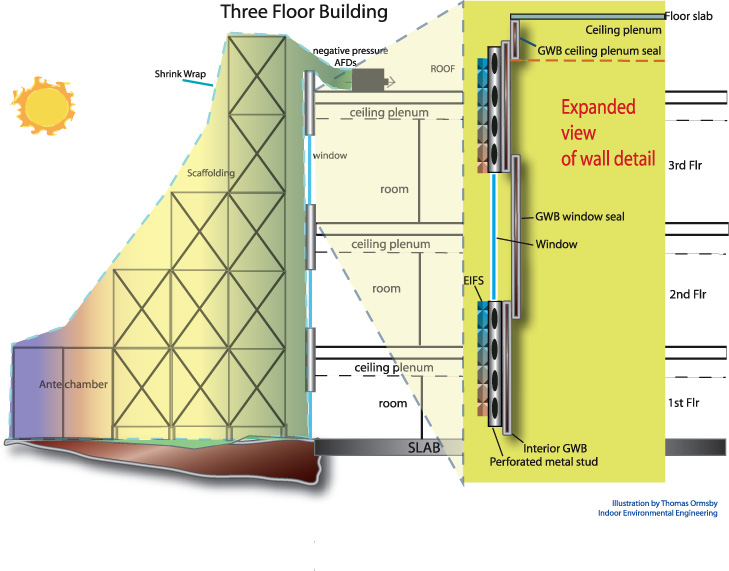
Typical exterior containment setup illustration
Illustration depicting a typical exterior containment setup for the project.
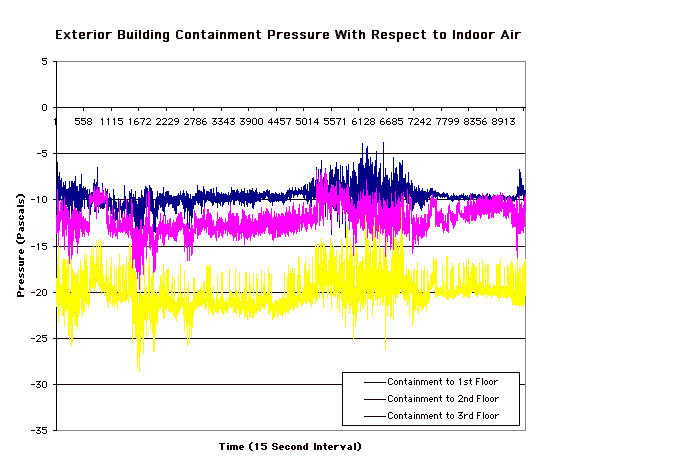
Typical pressure log chart
Chart from a typical pressure log during mitigation activities in the exterior containment.
Concealed mold growth inside wall cavity
Concealed mold growth inside of a wall cavity following capillary transport of water from the building concrete floor up into the gypsum wall board.
NOTE: The underlying moisture problem(s) must be correctly identified and mitigated or mold growth will recur.

Moisture Assessment and Control

The key element to preventing mold growth is to control moisture accumulation in building materials. Moisture accumulation can result from condensation of water vapor on cold surfaces as well as liquid and capillary flow of water. IEEs moisture assessments may include the following:

  • Infrared thermography
  • Building material moisture content measurements
  • Concrete water vapor emissions measurements
  • Indoor and outdoor air temperature, relative humidity and dewpoint data-logging
  • Building material surface temperature and dewpoint analysis
  • ASTM and AWMA water testing of windows and other building envelope elements to identify defect, and develop cost effective repair plans
Moisture assessment image 1
Moisture assessment image 2

Bacteria and Endotoxin

Using a similar approach to that used in our mold assessments (See above descriptions of: Assessment, Mitigation, Clearance) IEE performs investigations of indoor environments for bacterial or endotoxin contamination. Indoor concentrations of gram negative bacteria and hence endotoxin may become elevated in buildings that have chronic moisture problems. Abnormal indoor bacteria flora, such as fecal coliform gram negative bacteria (e.g., E. coli) may be elevated in the air or on surfaces of buildings that have had sewer line backups or toilet overflows.

Real Time Analytics